10.31.2009

Bill Watrous on Samantha

I know Jon usually posts the YouTube of the Week, but he's informed me that his posting might be sporadic for a while, so I've decided to step in where I can to keep things regular around here.

I was inspired to look up Bill Watrous on YouTube by my friend Joe, who recently saw him play live in Houston. I came across this recording of Watrous playing "Samantha", a beautiful ballad, and the video (while grainy) gives some amazing shots of his use of slide vibrato. Enjoy!


10.30.2009

on productivity

I just had the most interestingly productive practice session. This is how the span of about two hours went:
1. Picked up the horn and warmed up using my usual routine.
2. Walked over to my computer and answered an e-mail.
3. Picked my horn back up and did some flexibility exercises.
4. Checked on my applesauce which was cooking away in the kitchen.
5. Played some high range exercises.
6. My cat demanded to be played with, so I made her chase her feather toy for a few minutes.
7. I played through the second movement of the Kelly Sonata.
8. Potty break.
9. Worked through some tempo issues in the Kelly piece.
10. Answered a phone call.
11. Played through the whole second movement again, much better this time.
12. Put the horn down.
My chops lasted much longer doing this, and feel better afterwards, than if I just play for an hour straight -- and I probably got just as much accomplished, if not more. This reminds me a little of a typical rehearsal in any band -- you play for a few minutes, then you listen to the conductor tell you something, then you play for a little bit longer, then you sit there while the clarinets are being worked with, then you play again...

I have always heard that taking frequent breaks during practice can help the practice session be more productive. Joe Jackson writes that practicing in short, varied sessions is one of the seven habits of highly effective trombonists. It's difficult to do this when your only venue for practice is a practice room somewhere, but I have taken to leaving my horn out on its stand in the dining room to encourage myself (and anyone who happens to drop by) to pick it up randomly and play something. So far, it's made a big difference -- maybe I'm finally learning how to practice.

10.28.2009

You are not alone

I'm just going to go ahead and point out that I, Jon, and not Lauren, wrote this, in order to save some Facebook angst later. (lolz!)

I'm late again. But I've at least gone from thinking nobody reads the blog to being afraid to post because I always manage to tick somebody off. That's progress of some sort, right?

I take a great deal of solace from the idea that no matter how screwed up I think things are, no matter what grotesque emotion is gnawing at the frayed edges of my benumbed psyche, there's a song for it. Which means that at least one other poor sap had the same problem, and some other poor sap thought enough people had that problem to finance the record. In that spirit, I offer three songs that are speaking to me right now.

"No More", from Into the Woods, by Stephen Sondheim. It took me until I was about 30 before I realized how brilliant this show actually is, although part of that is that I usually can't brook Sondheim for all his clever antics. Although right now I'm cycling through the last three songs in the show: this one, "No one is alone", and "Children will listen". Also, I had never heard of this Kevin Dozier character who's singing in that clip until I started trying to find a decent youtube of the song, but he's pretty good!

"If I Didn't Believe In You", from The Last Five Years by Jason Robert Brown. A song about a guy desperately trying to shore up his wife and failing miserably for his own hubris. Don't we get to be happy, at some point down the line? (Apologies for the bad video, but Norbert Butz is awesome enough to put up with the poor quality.)

"Bruised", The Bens. That's Folds, Kweller, and Lee. I expect to take some shit for this one, because it's not a great song, and doesn't get into any sort of depth of emotion, but the hook has got me right in the emo pants: love just leaves you bruised.

10.25.2009

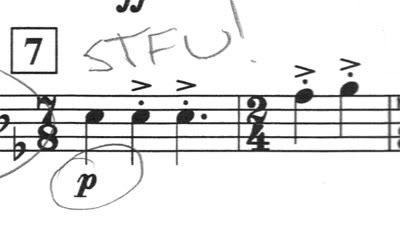
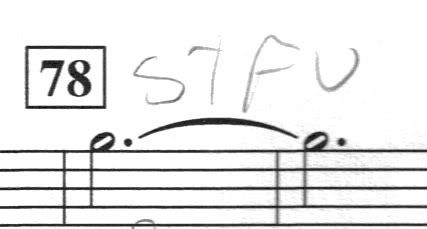
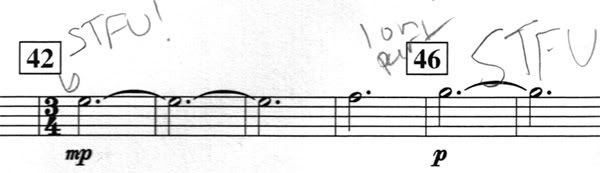
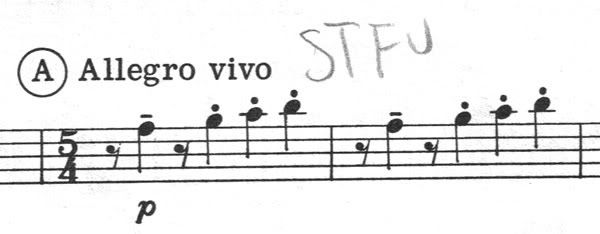
"stfu"

Today's Musical Annotation of the week is...


Yeah, that's right. STFU. While this does not have a direct translation into Italian, nor is it a common marking in printed music, somehow it seems to be a common penciled in notation in the first trombone music of the AWCB.


No, really.


"STFU" is a very nuanced marking. It does not merely mean to play quietly, but it is usually used to mark something that one feels should be played loudly, but really isn't supposed to be. 


(Some part of me wonders... in twenty years, will someone else be handed this music and raise their hand and ask the conductor "I have 'stfu' penciled into my part, what does that mean?")

10.23.2009

on language and trombonery

How did you learn to articulate? When I was first picking up the horn, I was taught "ta ta ta". When I got to college, my instructor beat "ta" out of my head and taught me "toe toe toe", and "low low low" for legato.

Obviously, the difference here is the vowel. /a/ and /o/ are both pronounced in the back of the mouth, but /a/ is lower than /o/. That is, your tongue is farther down in the back of your mouth when you say /a/ than when you say /o/. Try saying both "ta" and "toe" and stick your finger in your mouth and feel where your tongue is and the shape. The tongue kind of curves up in the back when you say /o/.

This seems counter-intuitive. Why would you want your tongue in the way of your airstream? However, the location and shape of the tongue has another effect. Try saying "ta ta ta", and put your hand on your chin. Your jaw moves, doesn't it? Now say "toe toe toe", and feel your chin again -- not so much movement, right? One thing you don't want when you play is a lot of jaw movement -- it moves the teeth, interferes with the placement of your lips, and can generally muck up your embouchure. By using "toe" instead, with less jaw movement, we learn not to move our jaw when we play just by thinking of a different syllable.

Try holding the horn with your left hand and articulating while feeling your jaw with your right hand. Think of saying different vowels when you tongue, and feel what happens.