Showing posts with label musical annotation of the week. Show all posts

1.24.2010

"l'istesso tempo"

We've all probably seen this one a billion times, but I remember making fun of it in high school.

l'istesso tempo


This literally means "the same tempo". A tuba player and I looked it up in high school and laughed -- "why would you need to tell us it's the same tempo?", we wondered. This term, however, comes with a connotation to it -- that being that the meter is going to change, but the conductor's beat should stay the same. That is, when one is switching from a 2/4 meter to a 6/8 meter, the beat will be at the same tempo but with different subdivisions.

1.17.2010

"prothalamion"

Today's MAotW is brought to you by Jon, who apparently encountered this term while reading about the Carpenters. (Wait, was I not supposed to post that publicly?)

prothalamion


At last, all that Ancient Greek comes in handy -- this term is clearly very Greek, as it parses into pro+thalamion, pro meaning "in front of" and thalamion being the word referring to the "woman's chamber" of a house. Nevermind that in the ancient world, women were "kept" on the second floor of the house, with a ladder that their husband could remove once he was sure that his wife was in bed...

But anyway: yes, this is a marriage song. It can also be referred to as epithalamion, which means essentially the same thing. It can also refer to a poem celebrating marriage. And now, an example, brought to you by our friend Purcell.


1.10.2010

"gravita"

One of the terms I remember having a small argument over in music school was...

gravita


This was the marking in an etude I was playing once in a lesson. I took it to mean what it looked like -- "graveness" -- so I played the etude with a sort of heavy sounding dirge style. However, when you look gravita up, the definition is "with gravity or majesty"; my problem with this always was that those two words mean quite different things... but do they really?

Gravity, aside from being that thing that keeps us all on the ground, means something like 'serious behavior'. My American Heritage Dictionary tells me that one of the definitions is 'solemnity or dignity of manner'. One of majesty's definitions in the same dictionary is, 'royal dignity of bearing or aspect; grandeur.' 


Here I thought that majesty usually would indicate something like 'splendor'. It is the mental image I get when listening to Pictures at an Exhibition: The Great Gate of Kiev (with obligatory cute kitten video, as per tVftBR rules).   

So my advice is that if you ever encounter gravita as a musical annotation, tread carefully. No, really; each note should be deliberately placed, like a queen walking to her coronation. 

1.03.2010

false notes

Today's MAotW is something a little different.

false notes


I encountered some of these suckers in this solo piece I've been noodling around with, Variations on a March of Shostakovich by Arthur Frackenpohl. Here's what they look like:


The directions in the music say, in Courier New font: "half-valve type sound, slap palm on mouthpiece or snap fingers, etc". I have been working at trying to make a "half-valve type sound", mostly by wiggling my trigger while trying to play these notes. I've found that a F in the staff with a trigger half-pulled makes a really unusual sound, but I do have a hard time accenting it. I may settle for a Joe Alessi-style yell or maybe make some linguistic clicks. 

My music dictionary tells me:
A muted or dampened notes that has rhythm but often no discernible pitch. It is often thought of as an implied note in a musical phrase and can be not performed or performed only faintly for effect. (...) The false note is indicated by a (parenthesis) around the notehead or with an "X" in place of the notehead, indicating that the note is to be played very quietly, as a ghost.
Trombonists have another use for the term "false note", although I first heard of them as "frog tones". This term refers to a sort of "ghost partial" between low E and pedal Bb played without the trigger. You can sort of make the notes half exist, with a thin sound and overtones that feel a little strange, and you can lip these notes to approximate the pitch. Some more advanced trombonists can produce false notes on and around a triple pedal Bb. Other brass instruments can do this too, as evidenced by the YouTube video below of a guy playing what sounds like the Meow Mix theme song on false notes on a tuba.


12.20.2009

"quodlibet"

The MAotW is:

quodlibet


This is a Latin term meaning "what pleases" (said "kwode-lih-bet"), but the musical meaning can only be described as "a piece made up of a bunch of familiar stuff". Bits and pieces of popular melodies can be knitted together in a musical composition to make up a quodlibet. I've never actually seen this word notated on a piece before, but it's a word I always wished I had to describe pieces like Instant Concert, the piece in the video below. And here, like an early (winter holiday of choice) gift, the word appears, ready for use!

Note: I chose this version of this piece because of the unforeseen wackiness factor of the Australian police!


12.13.2009

affrettando

Today's MAotW is brought to you by DayQuil.*

affrettando


affrettando (sometimes misspelled "affretando") means "rushed or hurried", and in music is used to indicate an accelerando that is to be done with an impatient or nervous tone to it.

Or, in the case of the AWCB's Christmas concert today, describes how Lauren plays the entire gig when she's hopped up on cold medication and, therefore, has an incredibly slow response time.

*Note: DayQuil actually did not sponsor this MAotW, but it was the cause of it!

12.06.2009

"con islancio"

The highly nuanced Musical Annotation of the Week is...

con islancio


You have probably only seen this annotation in one place: the last section of Chance's Variations on a Korean Folk Song. Wikipedia tells me that con islancio means "with impetuousness", and my usual online musical dictionary agrees. 


Well, at the rehearsals of the Great American Community Band, we heard something different. Yes, Variations was part of our concert lineup, and when Colonel Gabriel came to the con islancio section, first he made a jibe at younger conductors who tell their bands that this marking means "like the islands", but then he explained to us the meaning of this annotation in a much different way.  I can't quote him directly, but I can give you the gist of his explanation.
"islancio" is like a lancer, or someone throwing a lance. It builds up -- starts with slow muscle movements in just the fingers, then the arms, then the shoulders, the torso, the legs; eventually the whole body is moving until the lance is released
 If you listen to the very last variation (3:10 in the video below), the instruments add in one by one until, finally, the bass trombones and lowest brass drop in on a Bb -- this is the release of the lance.

And now, a recording with a figure skater, because if you're like me you never conceived of this piece as a skating routine, but now you will never be able to think otherwise.


11.15.2009

"tailgate"

Today's MAotW is:

tailgate
Wait, what?

 "Tailgate" is not actually Italian, believe it or not, but it is actually a slang term for glissando (also known as "glissing" or "smearing"), or the unique ability of the trombone to slide between two notes. This term is used to denote a Dixieland style of smear. The Virgina Tech Multimedia Music Dictionary gives this etymology for the term "tailgate":
The name tailgate comes from the late 19th century when the trombone performers in Dixieland bands would often perform sitting on or over the "tailgate" of a horse-drawn wagon, facing backwards, while the other members of the band sat in the wagon bed in a parade or in a procession on the way to a funeral. By sitting on or over the "tailgate", the trombone player had ample room to move the trombone slide while performing frequent glissandos of the Dixieland jazz that often require the performer to extend the slide to its maximum length.
And here you thought tailgating only had to do with football gameday activities. Hah!

11.08.2009

"ffz", "sffz", and "sff"

Today's Musical Annotation of the week is actually three annotations, but we'll start with...

ffz

I think most musicians get the idea when they see two Fs together, and when there's a Z involved, it usually means to smack the hell out of something. 

ffz is an abbreviation for "forzando" or "forzato". It basically means to play the note at the indicated dynamic (ff in this case) but with emphasis, as though it had a strong accent mark over it. 

Now, this term can be confused with two others:

sffz


sff

sffz is an abbreviation for "sforzato", which is to play at the dynamic level written (ff) and with a strong accent and at full duration, as below.


sff is an abbreviation for "sforzando", which is to play at the dynamic level written (again, ff) but with a typical accent mark, as shown below.

 So just remember -- if it's got a Z, it means it's a strong accent (Z looks kind of like a backwards S, and even the sound Z makes sounds stronger than an S, right?). If it's got an S and a Z, it means to play a long, strong accent (because the abbreviation is longer, and has that Z again). If it's just got an S, it means to play it like a regular accent (strong, but not as strong as a Z).


11.01.2009

"singhiozzando"

Today's MAotW (Musical Annotation of the Week) is:

singhiozzando

In my time as a trombonist, I don't think I've ever seen this marking, but perusing my dictionary this week I found it there waiting for me. It means to play the marked passage "in the manner of sobbing", usually characterized by a gliding between notes. 

The trombone being what it is, you'd think we'd get to play singhiozzando at least sometime -- we're pros at gliding! Maybe composers just don't think we can pull off the "sobbing" effect. Sigh!

10.25.2009

"stfu"

Today's Musical Annotation of the week is...


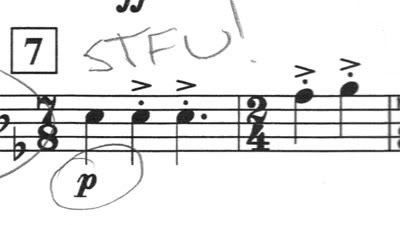
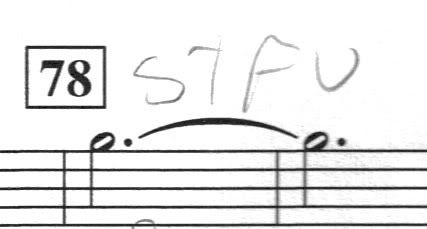
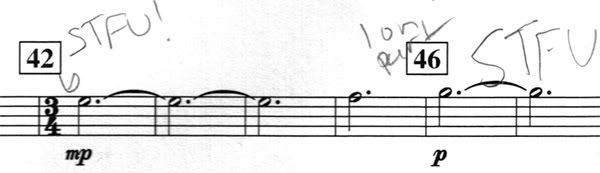
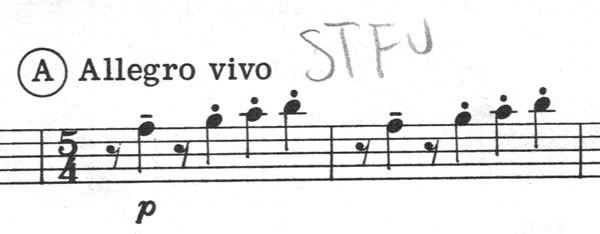
Yeah, that's right. STFU. While this does not have a direct translation into Italian, nor is it a common marking in printed music, somehow it seems to be a common penciled in notation in the first trombone music of the AWCB.


No, really.


"STFU" is a very nuanced marking. It does not merely mean to play quietly, but it is usually used to mark something that one feels should be played loudly, but really isn't supposed to be. 


(Some part of me wonders... in twenty years, will someone else be handed this music and raise their hand and ask the conductor "I have 'stfu' penciled into my part, what does that mean?")

10.18.2009

"ben"

Today's Musical Annotation of the Week is an adjective:

ben

I encountered this in the context ben sost. which I took to mean "ben sostenuto". I've also seen it in ben marcato and ben attaca as well as in many other directives.


Little did I know, ben is an abbreviation for bene, which means "good" or "well". But something like ben sostenuto doesn't mean "play good and sustained", it means "play well-sustained". What's the difference? ben sostenuto means to play the best sustained you can manage -- if someone were to look up sostenuto in their musical dictionary, there would be a recording of you playing this ben sostenuto passage. 

I must emphasize, however, that this does not mean that you can play "mediocre sostenuto" whenever you don't see a ben next to your sostenuto, or whatever annotation you're currently working with!  

10.11.2009

"vivace"

Today's Musical Annotation of the Week is:

vivace

Usually when I see vivace, something along the lines of "HOLY CRAP FAST" goes through my head. A lot of people, in my experience, confuse vivace with presto. presto is what I'm thinking of when I think "HOLY CRAP FAST"; vivace has a much more subtle meaning.

vivace means "lively" or "brisk"; often times, this goes along with a quick tempo. vivace is more about style than speed, however, so it frequently appears with a tempo marking like allegro vivace. I've never actually encountered presto vivace in my recollection -- but someone must have used it sometime!

While I was writing this post, the first example of vivace that came to mind was the first section of Brian Balmages's Summer Dances. I cannot quite recall if this piece is actually marked vivace, but the style is certainly what I think of.


10.04.2009

"a la barcarolle"

New weekly segment here on tVftBR: the musical annotation of the week! Each Sunday we'll present something that may be written into a musical piece that might confuse or astound the average musician. In some cases, it'll be something that we think we know, but we really don't.

The first one will be the one that inspired me to this endeavor:

a la barcarolle

a la means "as in" or "like", but what the hell is barcarolle? As it turns out, it's an alternate spelling of "barcarola".
barcarola: a style of music sung by the gondoliers in Venice, Italy, typically in 6/8 or 12/8 meter to simulate the motion of the boat moving through the waves of the water with the rhythmic rowing of the gondolier.
And here's an example of a famous piece a la barcarolle, "Belle Nuit" from Offenbach's The Tales of Hoffman.